Governance is not a one-time effort. It requires continuous assessment and refinement over time. Structured evaluation approaches establish a baseline, track progress, and measure maturity as organizations evolve.
Assessments clarify the current state, surface structural gaps, and inform a disciplined path for continuous improvement across enterprise architecture and data governance.
Key Assessment Types
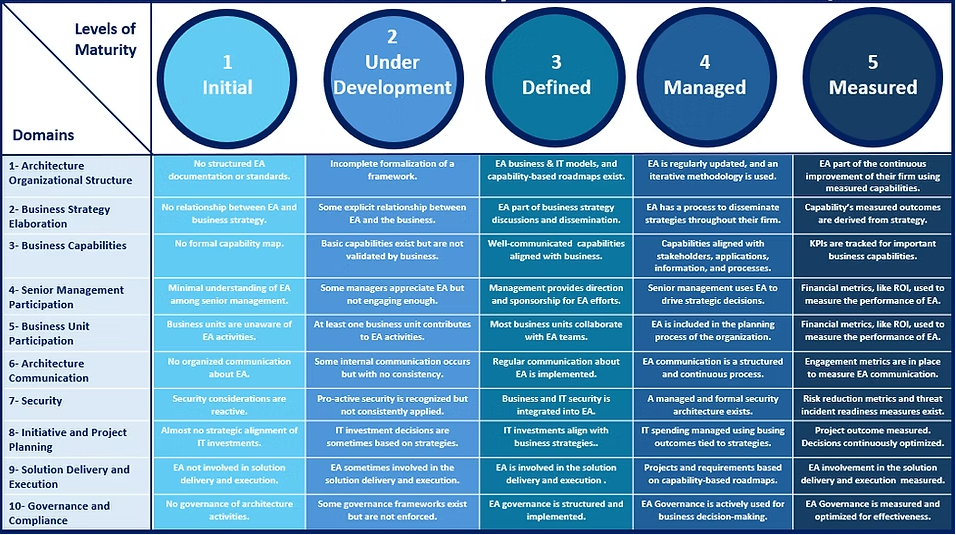
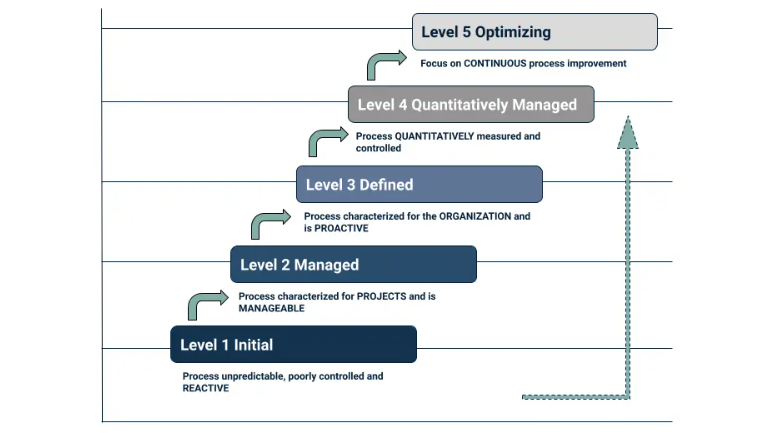
Architecture Capability Maturity Model
- Establishes the current state of enterprise architecture governance in the organization.
- Evaluates architectural processes, governance policies, and decision-making effectiveness.
- Uses a five-level maturity model to track progress, from Ad hoc (Level 1) to Optimized (Level 5).
- Helps align enterprise architecture with strategic business goals over time.
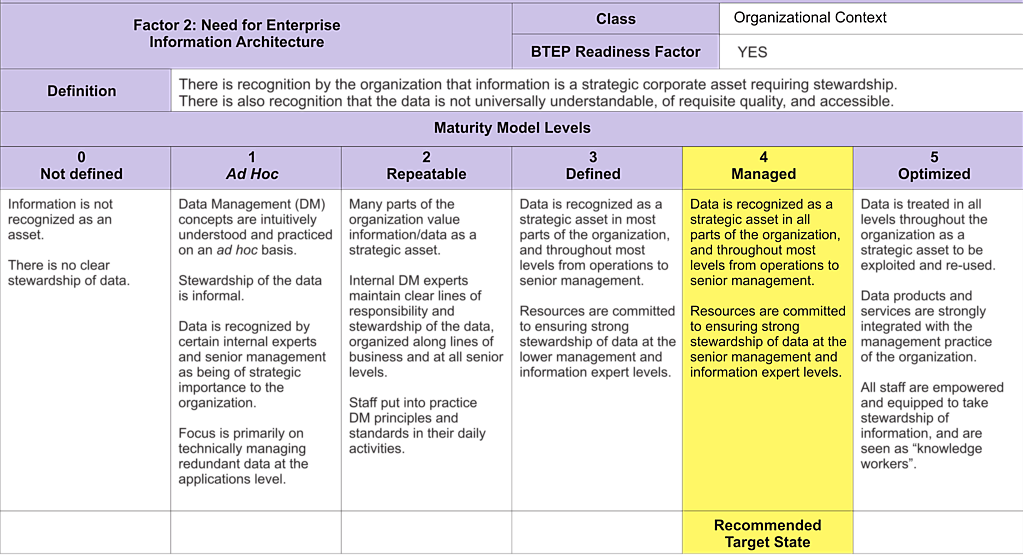
Readiness & Risk Assessment
- Conducted before implementation planning to assess readiness for change.
- Identifies organizational risks and areas needing stronger governance frameworks.
- Guides leadership in setting realistic implementation expectations based on current capabilities.
Data Governance Maturity Assessment
- Assesses data management practices based on DAMA-DMBOK principles.
- Covers domains such as data quality, metadata management, master data management, and data security.
- Provides a structured approach to incrementally improve data governance across business functions.
- Enables tracking of progress through maturity stages from Initial (Level 1) to Optimized (Level 5).
Data Quality Assessment Framework
- Evaluates data accuracy, completeness, consistency, and reliability across systems.
- Establishes data quality KPIs to measure compliance with regulatory and business requirements.
- Helps organizations identify gaps and improve data trustworthiness over time.
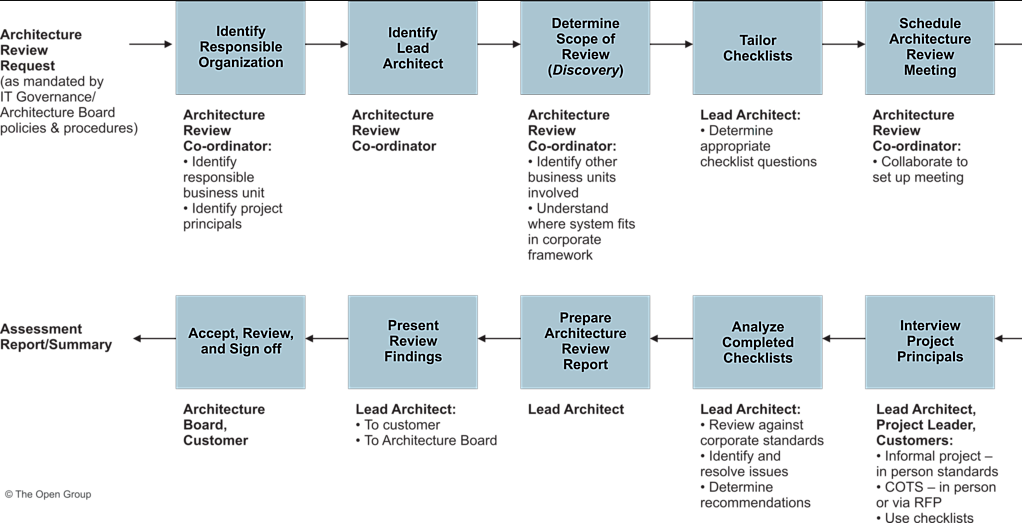
Architecture Compliance Review
- Conducted in implementation governance phase to ensure projects align with architectural guidelines.
- Identifies non-compliance risks and enforces corrective measures early.
- Acts as an ongoing checkpoint to sustain governance throughout project execution.
Data Modeling Assessment
- Evaluates conceptual, logical, and physical data models for consistency, integration, and business alignment.
- Ensures data modeling standards are followed to enhance interoperability across systems.
- Supports data architecture governance by tracking adherence to modeling best practices.
How These Assessments Enable Continuous Improvement
- Baseline Establishment: Use initial assessments to set starting maturity levels for enterprise architecture and data governance.
- Progress Tracking: Conduct periodic reassessments to measure governance improvements over time.
- Alignment with Business Objectives: Ensure that governance enhancements contribute directly to business goals.
- Risk Mitigation: Identify gaps and potential failures before they escalate into enterprise-wide issues.
Final Thoughts
Through disciplined and honest assessment cycles, governance becomes more than a formal structure. It becomes an enforceable organizational capability that exposes real weaknesses, not curated success stories.
Continuous improvement only occurs when leaders are willing to act on what assessments reveal, even when the results are politically uncomfortable. Without consequence, maturity models turn into reporting exercises, compliance reviews lose their authority, and data quality programs stall at surface-level progress.
Organizations that treat assessments as decision instruments rather than documentation tools build regulatory confidence, architectural integrity, and sustained trust in their data. Those that do not will continue to recycle the same governance problems under new frameworks and new initiatives.