“You can’t scale your data without scaling trust.” from “Data Mesh: Delivering Data-Driven Value at Scale” by Zhamak Dehghani
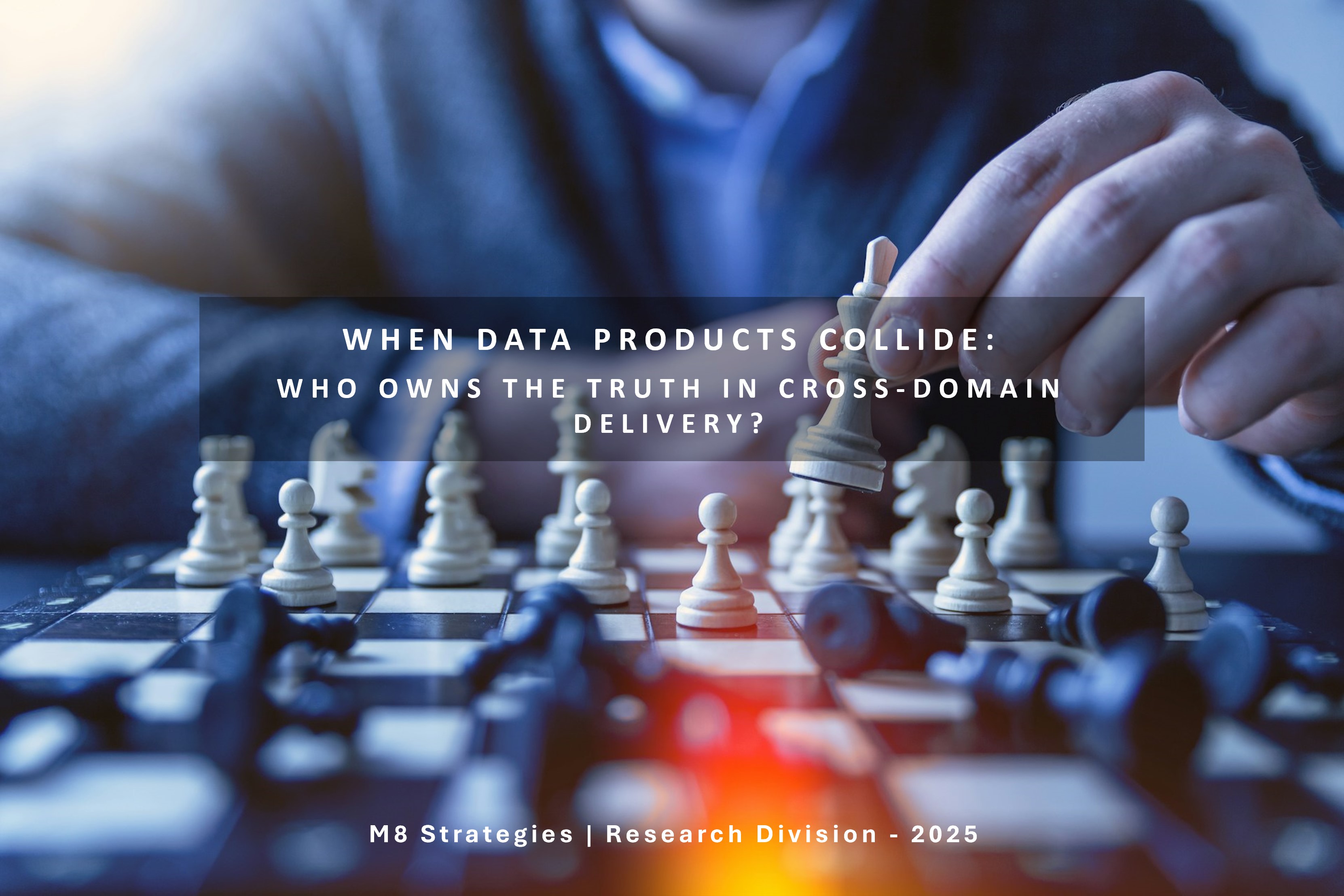
As organizations evolve into federated, domain-oriented structures, the promise of scalable, self-serve data products becomes both powerful and complex. But what happens when those products overlap, contradict, or serve competing interpretations of the same business entity?
When data products collide, the core question becomes: Who owns the truth?
This is not a failure, it’s a signal of maturity. It indicates your ecosystem is growing, your teams are engaged, and your domains are striving to deliver value. The solution isn’t to centralize back into rigidity, but to align with intentionality.
In a cross-domain environment, truth isn’t static. It’s contextual.
- Sales may view a customer as a lead
- Finance may see that same entity as an unpaid account
- Compliance may track them by regulatory classification
Rather than debating whose truth is “right,” leading organizations develop shared definitions, stewarded metadata, and traceable transformations. The answer isn’t one universal dataset, it’s a layered model of truths with governed alignment.
Principles for Navigating Product Collisions
Federate with Guardrails
Empower domains to build, but establish enterprise design standards, naming, lineage, traceability, and data contracts.
Elevate Stewardship Roles
Stewardship isn’t just about quality, it’s about cross-domain coordination. Invest in data product owners and cross-domain stewards who serve as translators between perspectives.
Establish a “Truth Arbitration” Process
Instead of firefighting duplicate metrics, create a governance process for resolving conflicts, driven by usage, not politics.
Use Metadata to Reveal, Not Control
Metadata catalogs aren’t just for documentation, they’re the bridge between producers and consumers.
Default to Transparency
When in doubt, expose lineage. If teams know how data was created, they’re more likely to reconcile than resist.
Concolusion
Cross-domain data collisions are not a sign of failure, they’re a feature of modern, dynamic data environments. The future isn’t about declaring a single truth, but designing systems where multiple truths can coexist, evolve, and serve their purpose.
With the right culture and governance, every collision is a chance to clarify, collaborate, and scale trust.